


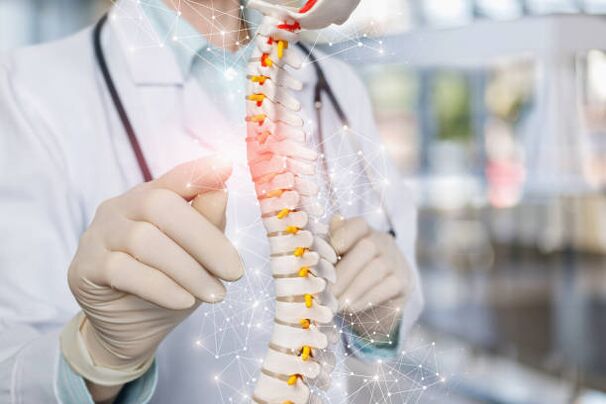
osteochondrosisIt is a disease of the spine, the characteristic feature of which is degenerative-dystrophic damage to the intervertebral discs and then to the vertebral tissues themselves.
Dystrophic changes in the disc cause the weakening of its outer fibrous annulus.Therefore, patients with osteochondrosis often experience such serious complications as protrusion (bulging of a part of the disc) and vertebral herniation (the nucleus pulposus of the disc hangs into the spinal canal).
According to the results of medical research, every second person experiences spinal problems after 30 years.In 70% of cases, the cause of pain in the spine is considered osteochondrosis, which is a neurological disease that affects the ligaments of the spine.
The first signs of spinal osteochondrosis do not appear immediately, but gradually.
Depending on the location of the pain, there are three types of osteochondrosis:
- Cervical region;
- Thoracic department;
- Lumbar region.
According to many experts who have studied this disease, the main cause of osteochondrosis is an incorrectly distributed load on the spine.As a result, in patients, directly in places where excessive physical pressure is applied, a change in the structure of cartilage tissue occurs.
Causes of spinal osteochondrosis:
- Hereditary predisposition to the disease.
- The presence of diseases of the endocrine system is a metabolic disorder.
- The development of orthopedic diseases, for example, flat feet, curvature of posture, diseases of the musculoskeletal system.
- Various injuries, bruises on the spine.
- Lifestyle: lack of activity, poor diet with a predominance of harmful foods.
- Having excess weight.
- Bad habits: smoking, alcoholism.
- Stress, fatigue.
- Pregnancy.
In most cases, the causes of osteochondrosis are associated with a person's professional activity.
Development stages
The development of osteochondrosis occurs in 4 different stages:
Osteochondrosis stage 1
It is characterized by the appearance of a pathological process in the nucleus pulposus of the intervertebral disc: its dehydration (dehydration) occurs, and subsequently the height of the disc decreases.At the same time, cracks begin to appear in the annulus fibrosus.At this stage, the patient usually does not feel any changes.Discomfort may occur when sitting in an unusual position for a person or when actively exercising.
Stage 2
In the second stage of osteochondrosis, the continuation of degenerative changes leads to protrusion of the disc.The spaces between the vertebrae are reduced and the fibrous capsule is destroyed.As a result, the roots of the spinal nerves are pinched, which causes the appearance of pinpoint pain, the intensity of which increases when bending, twisting and other movements.Possible weakness and decreased performance.
Osteochondrosis of the spine stage 3
It is characterized by abrasion of the cartilage lining between the discs;The thinning of the tissue is clearly visible if an x-ray is taken.The symptoms of spinal osteochondrosis are pronounced, intense, and the pain does not go away, and only strong pain relievers can relieve it.drugs.
Stage 4
The fourth stage is the most complex neurological disorders of the spinal system, expressed in partial or complete limitation of joint mobility.With this diagnostic condition, bone growths (osteophytes) form at the site of the vertebral joints, causing microtrauma to the nerve branches and adjacent segments of the spine.
Symptoms of osteochondrosis in adults
As the disease progresses, pathological mobility of the spine develops, in which soft tissues, nerve fibers and blood vessels located near the injury are infringed;This is how pain occurs.
The main symptoms of osteochondrosis:
- pain in the back, cervical region, lumbar area, shoulders and even ribs;
- discomfort, back stiffness during certain movements, lifting something;
- numbness of the extremities (arms and/or legs);
- feeling of pain in arms and legs, chills;
- muscle spasms;
- disturbances in the functioning of the genital organs;
- headaches, dizziness;
- pain in the heart area;
- sensory disturbance;
- muscle hypotension;
- increased fatigue, sometimes even in the eyes.
Excessive physical activity, overwork, hypothermia, injuries, concussions, and exposure to vibration can contribute to acute symptoms.
Complications
Degenerative processes that mainly affect the intervertebral discs cause a decrease in their density and the loss of their shock absorption functions.The consequence of such changes is excessive mobility of the spine, facet joints, muscles and ligaments are affected.
Paravertebral structures involved in destructive processes cause compression (compression) of the spinal cord and its nerve endings.As a result, a patient with osteochondrosis feels pain, which is accompanied by the following symptoms and diseases: severe headache, migraine, decreased visual acuity, autonomic dysfunction (VSD), dysfunction of the genitourinary system, sciatica (compression of the sciatic nerve), intervertebral hernia, spondyloarthrosis, lumbago, spinal stenosis.
instrumental methods for diagnosing osteochondrosis:
- X-ray diagnosis plays a key role in this disease.Conventional x-ray can reveal signs of the disease, such as a narrowing of the gap between the vertebrae.
- Magnetic resonance imaging (MRI) is a research method that allows accurate diagnosis of processes occurring in the spinal region.With its help, in particular, it is possible to determine the presence of a herniated disc and its location.
- Computed tomography (CT) is similar in its diagnostic capabilities to MRI.The disadvantage of CT is the presence of radiation exposure during the study.
Osteochondrosis treatment
There is no specific, single correct method of treating osteochondrosis;This process, under any circumstances, requires an integrated approach.
The comprehensive program traditionally includes the following components:
- physiotherapeutic influence methods;
- special exercises and massages;
- manual therapy methods;
- pharmacological treatment;
- reflexology, electrophoresis, etc.;traction.
When treating this category of patients, specialists prescribe drugs that have the following properties: relieving inflammation, restoring the functions of the musculoskeletal system, stimulating tissue regeneration of intervertebral discs and cartilage, and preventing the progression of osteochondrosis.
Treatment of osteochondrosis follows the traditional path of treatment of many diseases of the musculoskeletal system: NSAIDs are prescribed to eliminate the inflammatory process in the tissues, chondroprotectors to restore the level of synovial fluid, and corticosteroids, if the first two types of drugs are ineffective.
To get rid of osteochondrosis, various therapeutic procedures are used, including massage.It has many beneficial properties: muscle tone is relieved, blood flow in the spine is stimulated, and the intervertebral discs are strengthened.
Manual therapy relieves acute pain and helps restore posture.One of the most used methods is visceral therapy.During its implementation, high-quality treatment of the joints is carried out, blood circulation processes are improved, and the immune system is strengthened.Allows you to prevent the exacerbation of various chronic ailments.
Physiotherapy or exercise therapy for osteochondrosis is very important.Therefore, special exercises to strengthen the back muscles contribute to the formation of a muscle corset, which in turn ensures even distribution of the load on the spine.In addition, thanks to regular exercise, blood circulation and nutrition of tissues, including intervertebral discs, improve, the patient develops correct posture and the range of motion of the spine increases.
Physiotherapy helps to effectively combat painful manifestations in places where the pathological process is located.There are many types of physiotherapy interventions.Most often they resort to the use of magnetic therapy, ultrasound therapy and exposure to low-frequency currents.
Prevention
If osteochondrosis is prevented in a timely manner, it may not need to be treated.The issue must be addressed comprehensively:
- limit lifting heavy objects (less than 10 kg);
- carry loads only symmetrically (distributing the weight between both hands);
- perform simple physical exercises aimed at strengthening the spine, muscles and joints;
- swim regularly;